Geographer - Urban Planner
Chungking Mansion, a city within a city
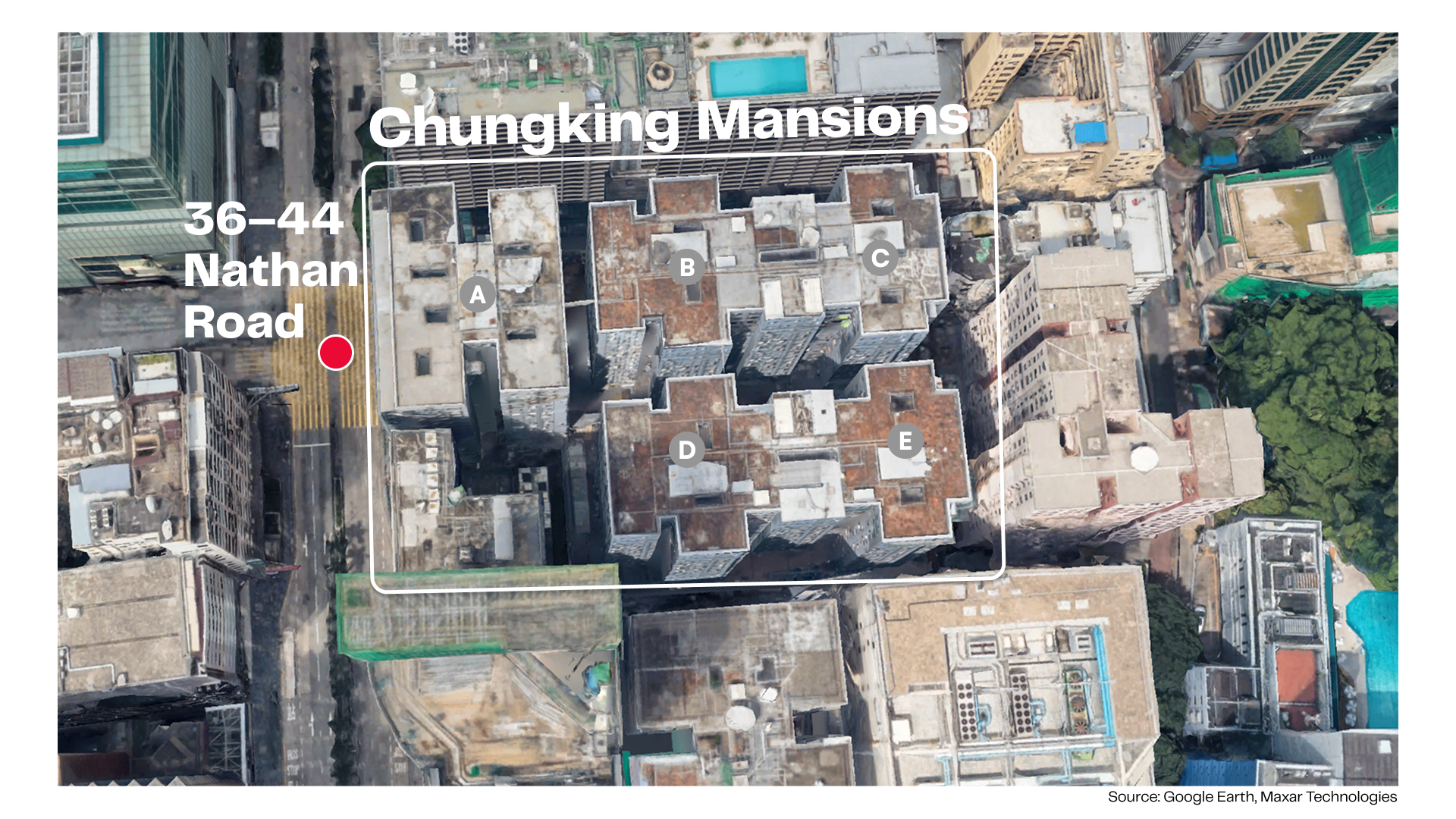
There are places that resist. While the neighbourhood gentrified at full speed, while shopfronts filled with advertisements for ten-thousand-dollar watches and interchangeable luxury boutiques, a cluster of towers held its ground. Grey, run-down, noisy, indifferent to its surroundings. Chungking Mansion.
I stayed there for about a month during my first visit to Hong Kong, in a room of roughly seven square metres shared with a friend. Six years later, on my second trip, I passed by briefly. Just long enough to notice that nothing, or almost nothing, had changed.
A melting pot of 130 nationalities
Built in 1961 on Nathan Road, in Kowloon, Chungking Mansion was intended as a residential building. Over the decades, businesses gradually colonised the upper floors, and the building became, without ever intending to, a rare example of mixed-use urban space. In one of the densest cities on earth, it reflects that intensity well : the ground floor and lower levels are given over to commercial stalls and wholesale trade, while from the third floor up to the seventeenth, the five blocks are mostly occupied by guesthouses. Corridors that multiply endlessly, smells of curry, fried food and new phones layering over each other from the moment you step inside. More than 10,000 people pass through every single day.
This is where several diasporas have gradually put down roots, often driven by the same economic logic. In the late 1990s and early 2000s, African traders arrived in waves, buying goods in Hong Kong and mainland China to resell back home. Before them, South Asian communities had already established their shops and guesthouses throughout the floors. South Asia, the Middle East, sub-Saharan Africa : each community found its footing here, in one of the most expensive property markets in the world, where the rest of the neighbourhood is effectively out of reach. A striking mix emerges between these long-established diasporas and backpackers passing through for a few nights, drawn by the lowest prices in Hong Kong.
Anthropologist Gordon Mathews, who spent a night in each of the building's ninety guesthouses, came to describe it as a "ghetto at the centre of the world", a phrase that captures both the isolation of its residents and their paradoxical connection to the rest of the planet.
In 2008, it was estimated that 20% of mobile phones in use across sub-Saharan Africa had passed through Chungking Mansion.
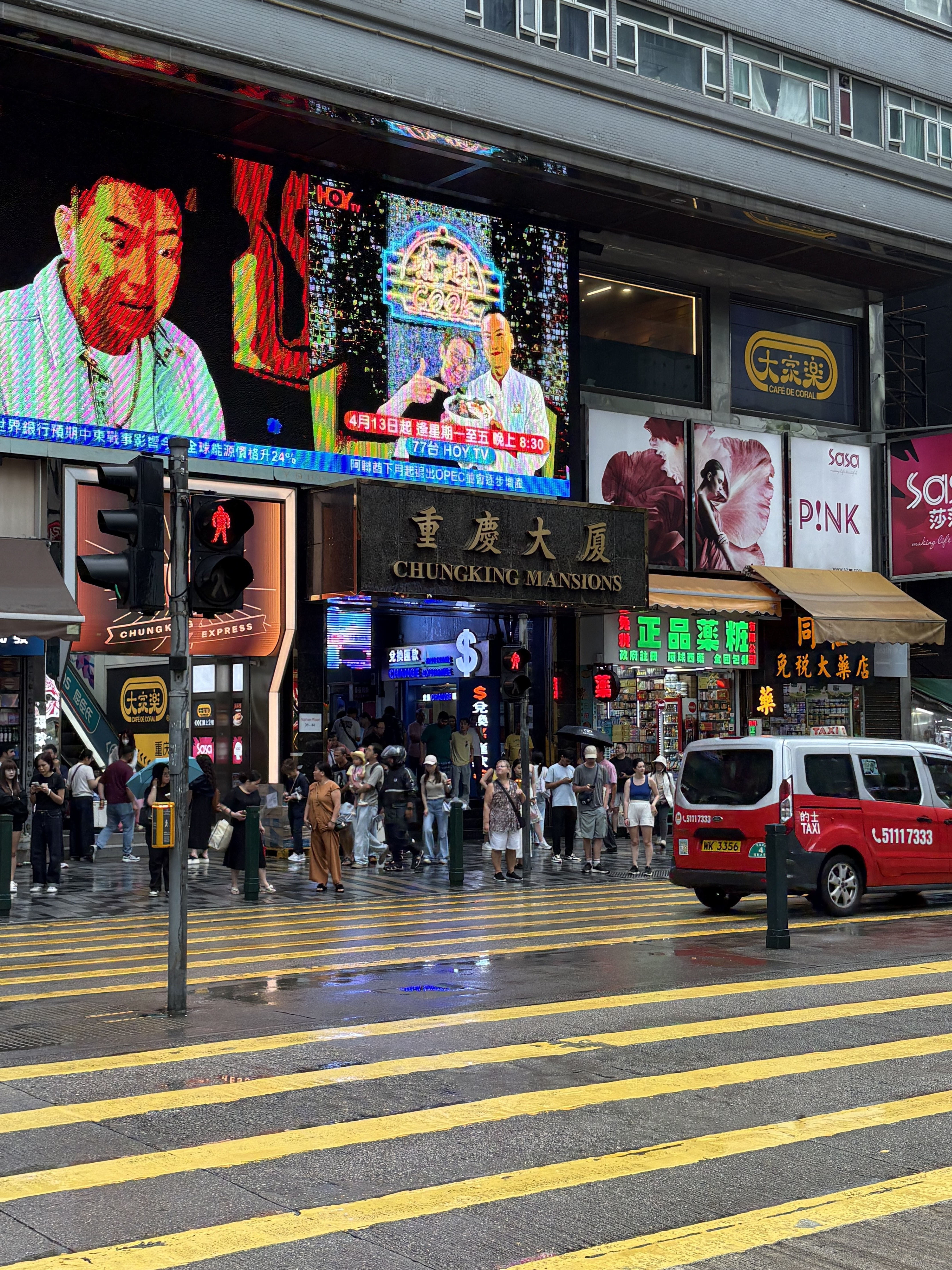
Behind the scenes
Wong Kar-wai's 1994 film Chungking Express gave the building a worldwide cinematic aura. Its cinematography captures the atmosphere of the corridors, the blue-tinted light, the feeling of a parallel world suspended inside the city. The film does not focus on the building's everyday life. That life plays out elsewhere.
During my stay, each tower had two lifts, one of which was regularly commandeered for deliveries or simply out of order. We quickly got used to taking the stairs, and learned fast that it was better not to forget anything before heading down. The stairwells form a world of their own : some people drink there out of sight during the day. Others sleep on the top landing at night, unable to afford a room. We used that same landing to reach the roof and take photographs, trying to avoid the camera that would summon one of the security guards.
The flatmate I shared the room with told me one day about a Frenchman who had been living there for around ten years, wanted for a crime in France, sheltered by the absence of an extradition agreement between the two countries. It seemed hard to believe. It was not so far from the truth : in 2019, a French air traffic controller, wanted for eight years for the murder of a colleague, was identified in Hong Kong. In 2021, he was still there, free, the authorities unable to act without an extradition treaty with France. For this kind of profile, Chungking Mansion follows an implacable logic : guaranteed anonymity, a tight-knit community, a city with no extradition.
A playground for the YouTube era
The place has not escaped content creators. In recent years, dozens of vloggers have come to film there in search of urban authenticity. Casey Neistat, one of the pioneers of the New York street vlog, had filmed there around the time of my first stay, in a video that featured the very slumlord from whom I had rented my room. The building has become an almost obligatory backdrop for anyone wanting to film "the real Hong Kong". The filters and presets inspired by Wong Kar-wai work particularly well here.
In a neighbourhood where prices per square metre rank among the highest on the planet, Chungking Mansion still stands. Perhaps that is its greatest strength.
